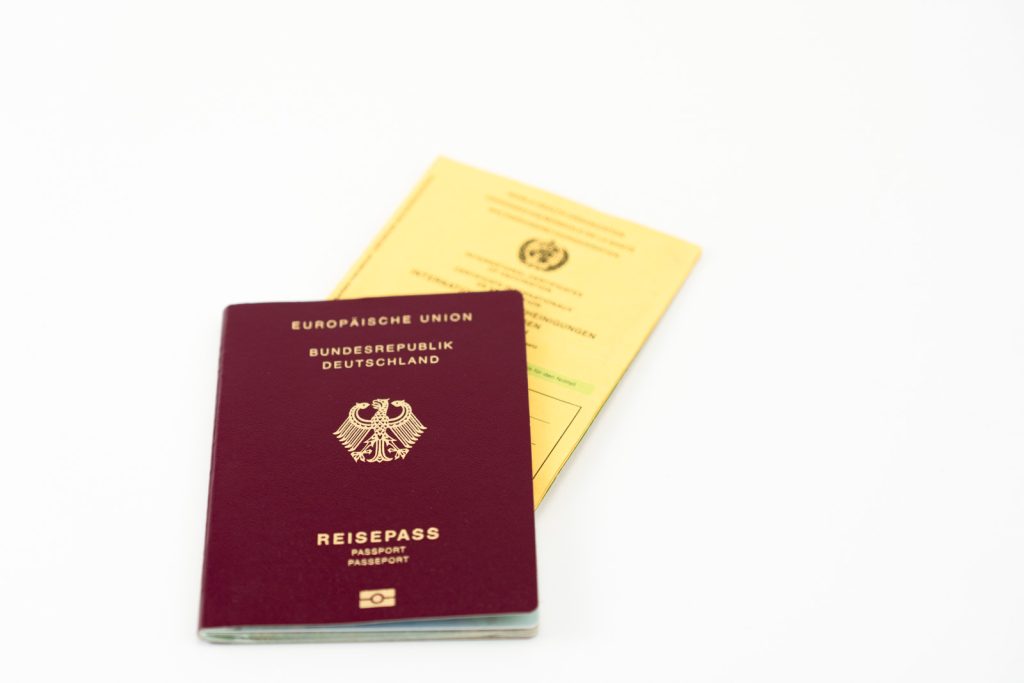
If you’re looking to settle down in Germany on a permanent basis and secure a German passport, there are a few hoops that you’ll have to jump through first, including getting German citizenship. So, here’s a complete guide for how to get a German passport as an American.
Let’s dive in and find out more!
Can I Get a German Passport Without Being a German Citizen?
Simply put, no, you cannot get a German passport without being a German citizen.
You need to claim citizenship of some sort, whether that’s full or dual citizenship with your current nation. Only after this has come through officially can you even begin to apply for your passport.
This is a lengthy process, but the German citizenship and passport come with a ton of great benefits and perks that I’ll go into further on in this guide.
How Can I Get German Citizenship as an American?
So, first things first, how can you get German citizenship as an American? Well, there are four possible routes to German citizenship, which are:
- By birth
- By naturalization
- By adoption
- Or by marriage
These are the only four routes into citizenship, so unless you fall into one of these categories, your German citizenship journey ends here. Unless you have a familial connection to Germany, chances are that you’ll be opting for the pretty lengthy naturalization process.
So, I’m going to go through each route individually because each one has its own criteria and process lengths. Check them all out, and you can figure out which route is right for you.
By birth
On the whole, there are two forms of German citizenship by birth, one by blood and one by soil.
So, what that means in real terms is that either you can claim German citizenship through your German parents or, in some extreme cases, you might be able to claim citizenship if you were born in Germany to non-German parents.
This only happens in rare cases, and if your parent isn’t German, they’ll need to have lived in Germany for at least eight years and hold permanent residency.
German citizenship by birth through blood is a lot easier to achieve. If one of your parents is German or both of them are, you should be able to apply for German citizenship. You’ll need to prove their citizenship and their familial ties to you as part of the process.
In certain cases, if your family members had their German citizenship revoked during World War II or if you have female German relatives who had to relinquish their citizenship when they got married in decades gone by, then they can contact the German government to get their citizenship reinstated. From then on, you’ll be able to apply for German citizenship by birth for yourself.
By naturalization
One of the most common ways to achieve German citizenship as an American is through naturalization. Essentially, this is when you live in Germany long enough to apply for citizenship.
So, in order to be eligible for German citizenship by naturalization, you need to live in Germany for eight years.
Sometimes you can lower this allowance by a couple of years by taking an integration test. This is basically a test that includes a ton of information about the culture, history, and customs of living in Germany.
You also need to meet a whole host of requirements, including a B1 German language level. Obviously, this takes a while to achieve, so it’s not the quickest path to German citizenship in the world, but it does seem like the most common way to get a German passport as an American citizen.
By adoption
If you’re adopted by a German citizen, you can get immediate citizenship as soon as the adoption goes through. It’s hands down one of the quickest ways to get German citizenship, but obviously, you need to be under 18 and meet all the German adoption laws and standards.
By marriage
There’s actually a specific citizenship path for people who want to become a German citizens through marriage.
You’ll need to prove that you’ve been married for at least two years to a German national, have lived in Germany for at least three years, be able to financially support yourself, and speak a good level of German.

In order to prove your language level, you’ll need to sit formal language exams in German, and these can get booked up months in advance. Add in revision time and processing time, and you’ll want to get started on your German requirements early in your citizenship process, trust me!
How Long Do I Need to Live in Germany to Get Citizenship?
The standard amount of time that you need to live in Germany to be eligible for citizenship is eight years; however, there are a few scenarios where this can be a lot less.
- If you’re applying for citizenship through naturalization and you complete an integration course, you only need to live in Germany for seven years.
- If you’re applying for citizenship through naturalization and you complete specific extra integration modules, you only need to live in Germany for six years.
- If you’re applying for citizenship through marriage, you only need to live in Germany for three years, but you do need to be married to a German citizen for at least two years.
- If you’re applying for citizenship by birth, descent, or adoption, you’ll get your citizenship immediately after the paperwork has been processed and approved.
What’s the German Citizenship Application Process?
So, now that you know all about German citizenship, it’s time to run through the application process. Like the majority of citizenship and visa application processes, it can take a long while for your citizenship to come through and take multiple stages to complete.
With that in mind, let’s dive in and find out more so that you’re prepared for this bureaucratic adventure!
Check your eligibility
First things first, you need to check your eligibility for German citizenship. If you haven’t lived in Germany for close to eight years or have some kind of familial connection or a German spouse, you’re not going to be able to get German citizenship, and your journey ends here for now!
If you have ties to German ancestors or are married to a German citizen, you are well on your way toward German citizenship and your very own German passport. Likewise, if you’ve been living in Germany for upwards of six years, you can be eligible for German citizenship if you’re willing to take an integration course or wait it out for the full eight years.
You need to make sure you hit all of the given criteria, not just one or two, so ensure that you read all the requirements really carefully!
Get your documents together
As with any level of German bureaucracy, the German citizenship application process requires a ton of paperwork. Now, you’ll probably have a lot of these documents from having to apply for your long-term German visas for all those years, but you’ll still need to take some time to collate them all together.

Of course, certain citizenship types will require extra documentation, but these are the core documents that you’re going to need:
- A valid passport
- Your birth certificate
- Proof of financial stability. This can be bank statements, job contracts, savings accounts, or a letter from your spouse or host saying that they are going to support you.
- Proof of language proficiency with a completed official certificate
- Pass the certificate for the naturalization test
- Residency permits
Other documents that you might need, depending on the type of citizenship that you’re applying for, are:
- Your marriage certificate
- Family book
- Adoption papers
- Extra integration course certificates
- Dependent birth certificates
Fill out the application form
Next, you’ll need to source and fill out the correct application form for your specific citizenship path. These are normally available from your local government authority, and you’ll need to read through them and fill them out carefully and truthfully.
There is also a series of instructions on the application form for how to proceed, so make sure you take note of these for future reference!
Take the citizenship test
Your next step is going to be to take the citizenship test if it’s a requirement of your chosen citizenship type. This is not necessary for every single type of citizenship, so make sure you check before you go through the hassle of taking the test.
The German citizenship test basically just assesses your knowledge of German culture, customs, laws, and society. It’s got a lot of crossover with the integration test, so if you’ve taken one, the other should come relatively easily to you.
Remember to give yourself plenty of time to book a test and revise for it, as they might get booked up in your area pretty quickly. Like with the language test requirement, it’s worth getting this booked in and sorted out relatively early in your application process to be on the safe side.
Pay your fees
Just before you submit your citizenship application, you’ll need to pay your application fees. Now, these vary depending on your type of citizenship.
This is mostly due to some citizenship types having more paperwork, so there are extra admin fees associated with them. However, these should all be made clear to you during your application process.
The cost of your citizenship application will also depend on your age. If you’re a minor, the cost is only 55 EUR, whereas if you’re an adult, it’s going to cost 255 EUR plus any additional fees. You need to have this money ready to submit at the same time as your application form.
Submit your application
Once you have everything in order, you’ll need to find your closest authority, which can be found through this link to submit your application. You have to submit your application in person, with all your documentation and your application fees.
I’d definitely recommend making a couple of copies of your paperwork before you submit it so you can have them on record. This way, if any accidents happen with your application, you won’t have to start completely from scratch.
Go for an interview
In certain cases, you’ll also have to attend a formal interview as part of your German citizenship application process. This isn’t mandatory for all citizenship types, so again, it’s best to check your specific application to find out what to expect and give yourself time to familiarize yourself with your completed application.
In this kind of interview, you’ll be asked questions all about your application, your background and history both in and outside of Germany, and your intentions for your permanent residency in Germany.
So, it’ll be nothing that you don’t already know, but you might want to bone up on your application so that you feel prepared and don’t get flustered during your interview.
Wait for your application to be processed
It’ll probably come as no surprise that German citizenship applications don’t arrive quickly. On average, you’ll need to wait at least a couple of months before your application is processed and you hear back from the German authorities.
Patience is absolutely key to the German citizenship process. It’s not going to be an overnight result, and it’s going to take longer than waiting for your standard visa extension. During this time, the government is also doing background checks, application checks, and more, so it’s bound to take longer than you might initially expect.
Take your oath at a special ceremony
Once your German citizenship application is approved, you might have to attend a special oath-swearing ceremony. This isn’t always the case, so you might not have to attend, but if you do, you’ll go to an official building where you can swear your allegiance to Germany.
After you go through the ceremony, you’ll be given your German citizenship certificate – congratulations! This will serve you as your proof of citizenship, so do not lose it. Make copies, and keep the original version somewhere safe.
Get your citizenship certificate
If you don’t have to attend a specific oath-swearing ceremony, you should receive your citizenship certificate either in person or you might have to pick up your certificate from a local government authority.
Again, keep this safe, make some copies, and lock the original away somewhere where it won’t get damaged. It costs more money to get an additional copy of your citizenship certificate if you lose it, and it can take a couple of weeks to arrive as well!
Apply for your German passport!
Now that you have your freshly minted German citizenship, you can now start the process of applying for your German passport. In order to get the ball rolling, you’ll need to head down to your local citizens’ office or Bürgeramt.
You absolutely have to go down and do this in person. They will not let someone else fill in the forms for you, so wander down and take the time to put in your application in person.
Can You Get Dual Citizenship in Germany?
Yes, you can get dual citizenship in Germany, but only in specific cases and if your existing country also accepts dual nationality. Not every country allows its citizens to share citizenship, so you may have to renounce one of your nationalities to proceed.
This decision shouldn’t be taken lightly, as this can have implications for taxes, business issues, work rights, travel allowances, seeing family, and more.
The main ways that you can secure dual citizenship in Germany are:
- If you’re a citizen of the EU or Switzerland
- You have multiple citizenships through birth or descent
- If you’re vulnerable i.e., an asylum seeker or refugee
- If your home nation won’t allow you to give up your citizenship in the first place
Of course, this only works in specific cases, so be prepared to renounce one of your citizenships if necessary.
What Are the Pros of German Citizenship?
Honestly, there are so many pros of having German citizenship. One of my personal favorites is that you never have to go through the visa application process again, which is one of the worst bureaucratic experiences.
However, there are also a ton of other benefits to take advantage of, such as:
- Access to the EU, including;
- Freedom of movement within the EU
- Freedom to work across the EU
- Business access to the EU
- The ability to vote in German elections
- The ability to run for German elections
- Access to social care and education
- Access to consular protection all around the world
- Citizenship in one of the best economies in the world
So, with this many benefits, it’s well worth going through the lengthy German citizenship process if you’re eligible.
Can I Lose My German Citizenship?
Yes, you can have your German citizenship revoked, but only in extreme circumstances. The main ones are acquiring your citizenship illegally in the first place or if you perform activities that are harmful to Germany, like terrorism.
It’s incredibly difficult to lose your German citizenship, and it’s not something the government does lightly, especially if it ends up leaving you stateless.
So, try not to get into serious trouble and obtain all your citizenships legally and with government permission, and you’ll have nothing to worry about!
What Documents Do I Need for a German Passport?
You actually don’t need a ton of documentation to apply for a German passport. In order to apply for your passport, you’ll need to bring the following documents to your local citizens’ office or Burgeramt.
- A recent photo in line with Germany’s strict passport photo requirements
- Either an expired passport or an identity card
- Proof of your German nationality, which will be your citizenship certificate in this case.
The reason that you don’t need a huge list of documentation is that the government has already seen and approved it all during the citizenship process, so they don’t need to see it again! Welcome to the low paperwork life of finally being a German citizen, people!
When you go to the Burgeramt, they will also get a copy of your biometric data through your fingerprints, so don’t be surprised when you get asked for this at the time.
How long does it take to receive a German passport?
The time it takes to receive a German passport can vary anywhere between three and six weeks. This is largely because all of the passports are all created at the Federal Printing Office in Berlin, so the proximity to the city can have an impact on how long the process takes.
After all, you have to account for the postage time for your initial application to get to Berlin, be vetted, and come back again. So, make sure you give yourself plenty of time to apply for your German passport before you plan to leave the country on vacation!
How much does it cost to get a German passport?
The cost of a German passport varies based on a couple of different things.
- Age bracket
- Expedited service
- Size of the passport
There are three age ranges;
- Children (0-18)
- Under 24 and
- Over 24
There are also two lengths of passports that you can choose from. They come in either a standard 32-page passport or a longer 48-page passport, which is ideal for frequent travelers who need more pages for stamps and visas!
Another difference is the speed of service. If you want to get express service, you can pick up your passport just three working days later, as long as you submit your application by 12 pm.
So, through mixing and matching these options, the cost of a passport can be anywhere from 13 to 114 EUR.
There’s also an extra fee if you want to apply from overseas. This is an extra 21 EUR per passport on top of the initial cost, so you’ll need to take this into account.
Here are all the combinations you can choose from.
Type of Passport
Price
Child passport
13 EUR
Under 24 (32 pages)
37.50 EUR
Under 24 (48 pages)
59.50 EUR
Expedited passport under 24 (32 pages)
69.50 EUR
Expedited passport under 24 (48 pages)
91.50 EUR
Over 24 (32 pages)
60 EUR
Over 24 (48 pages)
82 EUR
Expedited passport over 24 (32 pages)
92 EUR
Expedited passport over 24 (48 pages)
114 EUR
Is a German Passport Better Than a US Passport?
According to the Henley Passport Index, which is the official global passport power ranking index, German passports are much more powerful than American passports.
German passports rank as the 3rd most powerful passports in the entire world, while the US is down in seventh place. This index ranks countries according to global mobility.
So, what this means is that the more places you can go to without having to get a visa, the stronger the passport is.
So, simply put, with a German passport, you can visit more countries without a visa than you can with a US passport. This means that you have a lot more flexibility if you’re looking to travel, as you don’t have to wait around for a visa to be approved or pay expensive visa fees.
How Long Do German Passports Last?
If you have a child’s passport, it’ll last for six years, and if you have an adult German passport, it’ll last 10 years.
The reason that it’s shorter for children is that they grow up and change so often that you have to get new passport photos to keep it working effectively as a valid ID, but that’s also why they’re only 13 EUR apiece.
Of course, if you’re getting married or legally changing your name for another reason, you need to get a new passport to align with your official documents. So, if this is the case, your passport might not last the full 10 years.
Is German citizenship powerful?
Yes, German citizenship is very powerful, and together with Spanish, Italian, French, Finnish, and Swedish citizenship, it offers the most powerful passport and citizenship combination in the whole of Europe.
Thanks to its alliances and freedom of movement agreements with other countries, as well as visa-free entry requirements for a whole host of nations all around the world, German citizenship is one of the most powerful citizenships in the world.
As such, it’s very sought after, especially considering the access to the European Union and high-quality economy. This is why their citizenship process is so lengthy and rigorous.
Which Country Has the Most Powerful Citizenship in the World?
Even though German citizenship is one of the most powerful citizenships in the whole world, there are a few countries that beat it in the Henley Passport Power Index. The most powerful citizenship in the world, as of the 2023 ranking, is Singapore, with Japan coming in a close second.
After that, you’ll find Germany, France, Italy, Spain, Sweden, Finland, and South Korea at joint number three. So, Germany is pretty great in terms of citizenship power, considering it’s number three out of nearly 200 countries!
What is the Hardest Citizenship to Get in Europe?
Despite the steep requirements of getting citizenship in Germany, it’s not actually the most difficult citizenship to get in Europe. That prize actually goes to Germany’s neighbor, Austria.
With a 12-year living requirement before you can even apply for citizenship, it’s a long road to get an Austrian passport, voting rights, and access to the European Union.